1. The Condensation vs. Weather Barrier Matrix
A shelter does not generate heat; it arrests convection and sheds precipitation. The fundamental conflict in all backcountry shelter engineering is the balance between air exchange and moisture barrier continuity. Every sleeping human exhales between 400 and 800 ml of moisture overnight. In a poorly vented single-wall shelter in high humidity (above 85%), this water vapor condenses against cold fly fabrics, creating an internal dew point that drips onto down sleeping insulation.
Double-wall construction isolates the occupant with a breathable inner canopy, allowing vapor to pass through and condense on the outer fly interior away from sleep systems. However, this adds 300 to 700 grams of fabric and separate pole segments to your pack.
2. Structural Geometries Under Wind Shear
When wind hits a tent wall, it creates low pressure on the leeward side and high compressive pressure on the windward panel. A flat-sided tunnel tent aligned parallel to prevailing gusts can withstand 80 km/h winds effortlessly, yet collapses catastrophically if wind shifts 90 degrees into its broad flank.
Pyramid ("Mid") shelters utilize steep 45-degree slope angles that deflect gusts downward into the ground perimeter. Because the central compression force is borne by vertical trekking poles or dedicated carbon center poles, there are no flexible hoop poles to invert or snap under gust loads.
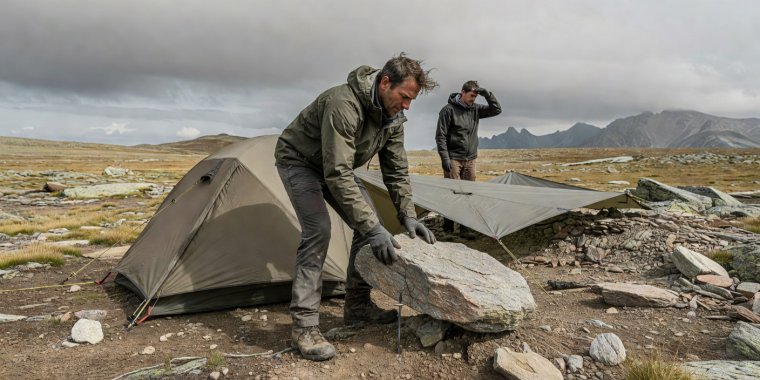
In 90% of structural shelter failures, the fabric does not tear first. The initial failure point is stake withdrawal. If a corner stake pulls loose in 60 km/h winds, the slack fabric immediately flogs violently, snapping guylines or shearing perimeter stitching within seconds.