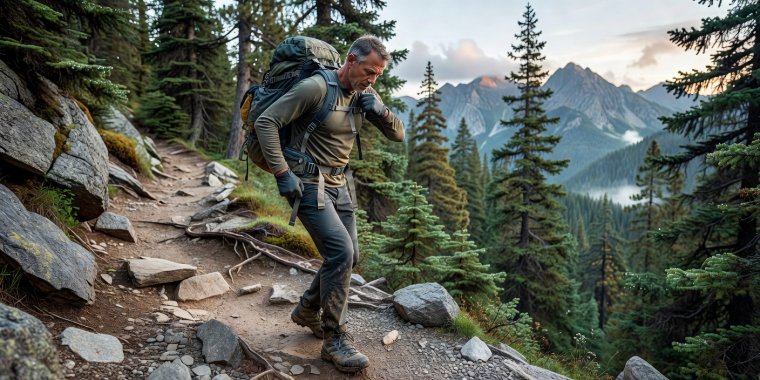
Carry Systems That Fit
How frame mechanics, lumbar contact zones, and trekking pole stabilization dictate long-distance stamina and spinal preservation on steep topography.
1. The Mechanical Reality of Load Transfer
A technical backpack is an external skeleton. In casual trail conditions, a frameless sack with shoulder straps suffices for lightweight loads under 8 kg. Once multi-day gear lists add high-volume insulation, dry-camp water bladders, and technical gear, overall pack weight frequently reaches 15 to 22 kg. At this threshold, soft frameless packs sag, rolling weight away from the hiker's center of gravity and producing severe shoulder trap fatigue and lumbar strain.
True internal frame systems use either dual pre-curved aluminum stays or a perimeter spring-steel loop backed by a high-density polyethylene (HDPE) sheet. The goal of this structure is torsional flexibility paired with vertical rigidity. As your hips pivot with each uphill step, the pack must accommodate rotational movement without collapsing downward onto the spine.
The Hip Belt Sizing Dilemma
Many hikers purchase pack sizes based on their pants waist size. Hip belts must sit directly over the bony crest of your pelvis (the iliac crest), typically 5 to 7 cm higher than a casual belt line. If the hip belt padding leaves a gap wider than 10 cm between buckle ends, weight transfer degrades rapidly.
2. Suspension Architecture Comparison
Below is an objective evaluation of common pack suspension categories across multi-day mountain routes.
3. Trekking Poles as Kinetic Load Reducers
Poles are not passive walking sticks; they form an active four-point kinetic gait system. By engaging the latissimus dorsi, pectoral muscles, and triceps, a hiker transfers approximately 5 to 8 kg of downward force per stride away from the meniscus and quadriceps.
Material Properties: Aluminum vs. Carbon Fiber
7075-T6 Aluminum: Possesses plastic deformation qualities. Under extreme shear forces—such as slipping between two river boulders while descending—aluminum bends rather than snapping cleanly. In technical wilderness routes, a bent aluminum pole can be wedged in a tree fork and partially trued to survive the remaining descent.
High-Modulus Carbon Fiber: Provides superior vibration damping and virtually zero swing weight, reducing wrist and forearm tendon fatigue over 30-kilometer days. However, carbon suffers from catastrophic brittle failure under lateral impact. If an external strike scores or crushes the resin matrix, the shaft can abruptly shatter under compressive weight.
Locking Mechanism Reliability
External cam lever clamps (often termed FlickLocks) rely on stainless steel screw pins pressing an aluminum or composite collar against the shaft. They are easily field-adjusted using a multi-tool or pocket knife. Twist-lock internal expanding mechanisms rely on internal friction plugs, which frequently freeze or slip when invaded by fine trail silt or glacier silt runoff.